| English |

Page d'accueil Au sujet du CESFP Politique axée sur la recherche Projets de recherche Contactez le CESFP Sites complémentaires
Santé des femmes autochtones
|
LIVING
WELL: Aboriginal Women, Cultural Identity and Wellness A Manitoba Community Women's Project |
| A. Wilson |
| Cette étude a été subventionnée par le Centre d'excellence pour la santé des femmes - région des Prairies (CESFP). Le CESFP est financé dans le cadre du Programme de contribution pour la santé des femmes, lui-même administré par le bureau pour la santé des femmes et l'analyse comparative entre les sexes à Santé Canada. Les opinions exprimées ici ne reflètent pas nécessairement le point de vue du CESFP ni la politique officielle de Santé Canada. |
| Rapport complet (en anglais) format PDF (607Kb) |
|
Aboriginal Women, Cultural Identity and Wellness A Manitoba Community Women's Project Abstract Traditional understandings of health and wellness in Manitoba's Aboriginal communities are distinctly different from understandings that have conventionally prevailed in most of the province's health care institutions. This research project, undertaken by an Aboriginal Women's Health Research Committee supported by Prairie Women's Health Centre of Excellence (PWHCE), seeks to extend our understanding of the positive impact of cultural identity on the wellness of Aboriginal women in Manitoba and our understanding of the ways that Aboriginal women have retained and drawn upon cultural values, teachings and knowledge in their efforts to heal themselves, their families, and their communities. It includes a review and analysis of current research relevant to Aboriginal women's identity and wellness, and presents the results of group discussions and individual interviews with Aboriginal women in Manitoba that focused on their personal experiences and understandings of the relationship between identity and wellness. The Aboriginal women who participated in this research project take care of their health and wellness by attending to and maintaining balance between all aspects - physical, mental, emotional and spiritual - of their being. The women's identities are inseparable from their family, history, community, place and spirituality, and understood in the context of their whole lives. Health care practitioners, providers and policy makers, as well as federal and provincial governments, need to assist Aboriginal communities in the development of the infrastructure, human resources and administrative structures needed to create and control health care services that are rooted in the cultural practices and values of the Aboriginal women and men they are serving. Further research into the connection between the well-being and identity of Aboriginal women, for example research that focuses on the identity and well-being of Aboriginal women in remote communities, will enhance our understanding. 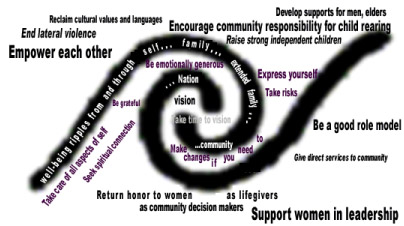 
Ce site Web est protégé par un droit d'auteur déposé par le Centre d'excellence pour la santé des femmes - région des Prairies, © 1998-2007. Veuillez faire parvenir vos commentaires et vos questions à l'adresse pwhce@uwinnipeg.ca. (Dernière mise à jour: ) 
|